







She’s taken night trains across the world. Here are her essential tips for Interrailers
Rachel Schnalzer, Senior Writer
23 July 2026

Journalist and writer Monisha Rajesh on the Royal Scotsman night train (credit: Monisha Rajesh)
There’s a specific moment that happens on every night train journey. In the early hours of the morning, when you first open your eyes and slide the window curtains aside to reveal what awaits outside.
“It could be absolutely anything,” said writer and journalist Monisha Rajesh, with a laugh. “It could be a station, it could be a whole load of people looking at you, it could be just the sunrise coming up over a field.”
For Monisha, this moment of surprise—and wonder—keeps her returning to night trains, time and again.
“I've never pushed up a blind and thought, ‘Ah, that's not very interesting,’” she said. “It's always something amazing.”
I recently spoke with Monisha, the author of Moonlight Express: Around the World by Night Train, about her favourite European routes, tips for first-timers, travelling with children and advice for getting a decent night’s sleep onboard a sleeper train.
This conversation has been condensed and edited for length and clarity.

The European Sleeper, one of many night trains travellers can take across Europe
What’s something you love about night trains?
In a practical sense, night trains help you save on the cost of a hotel. But in a deeper sense, I love the fact that they give you time. From the moment you board until the next morning when you arrive in your destination, you have a whole stretch of time to do whatever you want with. That's something that we don't really give ourselves very much anymore.
Night trains also allow you to reconnect with people. If you're travelling with old friends or family, they give you time to talk. The layout of the train specifically creates the opportunity for that to happen; you're travelling in such close confines with people that it does push the types of in-depth conversations that you tend not to have on a day-to-day basis.
What’s your advice for someone who is about to take their first night train?
Night trains can be quite tricky if you're not used to the movement of the train—don't expect to sleep the whole night through. But there are things you can do to prep your room so you can be comfortable.
One of the first things that I do is take down anything that's going to rattle. I take all the coat hangers off the wall and make sure that all bottles are lying flat, so that nothing will clink through the night. When I go to sleep, I make sure the blinds are fully down.
I always take a pair of bed socks to wear, because you never know what the temperature is going to be like onboard, and I bring a silk sleeper sheet, which is great in warmer weather.
I also bring a sleep mask, ear plugs and dry snacks in case there’s no dining car onboard. And I bring sachets of tea, because you can usually get hot water even if there’s no dining car.

Monisha sitting in the dining car onboard the Royal Scotsman night train (credit: Monisha Rajesh)
In addition, bringing a fully charged battery pack for my phone is useful because you have no idea how many charging sockets are going to be available. And it’s good to bring cash, especially in case the card machines aren’t working either.
Overall, though, don’t pack too much. Storage is limited in some compartments, especially if you're sharing with other passengers. Just take what you really need.
Generally speaking, expect the unexpected and be open to anything. Be willing to push yourself out of your comfort zone a little bit. Go sit in the dining car, even if you don't know anybody there. Have a go at chatting with people. I think people onboard sleeper trains tend to be very open to conversation.
What are some memorable conversations you’ve had on night trains?
On the train from Berlin to Stockholm, I really enjoyed speaking with a father and his young son. Having small children as well, it was really nice to find another parent who was introducing their child to train travel early.
The dad said that wherever they go, he tries to take trains with his son. He deliberately books them in the same compartment as strangers, so that his son will start to trust people and be able to pick up on any English that may be spoken during the journey.
A lot of people are quite nervous about taking children on trains, because they just don't know what the facilities are going to be like. The logistics of travelling by train with kids can feel overwhelming. And that's why I included my children in my book, because I wanted readers to see that it's possible.
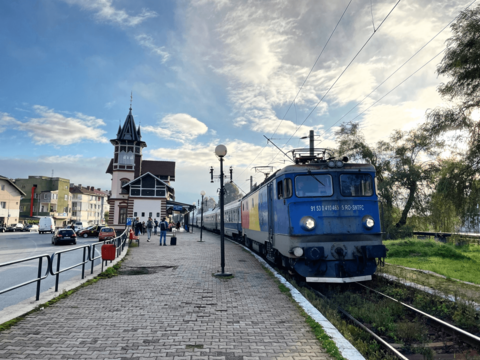
A night train from Vatra Dornei to Bucharest in Romania
Do you have any tips for those who are considering travelling by night train with their children?
Just a little bit of forward planning can make a massive difference. I took my daughters on a two-week Interrail trip, just the three of us, last May. They were seven and five at the time, but I had them each carry their own backpack—no rolling bags. I wanted to be able to hold their hands at all times in train stations.
We deliberately didn't take any iPads; I wanted my daughters to have a slow, immersive journey. Instead, we brought card games and colouring books. It sounds old-fashioned, but it made a really big difference. Kids also seem to find each other really quickly—my daughters made friends with children in the compartments next to us.
We were quite practical about food and made sure that we arrived at each station with enough time to get food and water to take on the train. It’s good to get all your food shopping done early, in case the in-station supermarkets are closed when you arrive.
One tricky thing can be arriving at your destination early in the morning. Typically, you might have to wait until 15:00 to check into your hotel, so I recommend booking a hotel that offers an early check-in (for example, The Hoxton hotels).
If our night trains were scheduled to leave late in the evening, I would get my daughters into their pyjamas before boarding and put their trainers and a jacket on over top. That way, they didn't need to change onboard the train. I also brought slip-on shoes for them because you don't want to be tying laces in the middle of the night when you're going to the toilet.
In general, small things can make everything a little bit easier, such as packing your toothpaste and a spare toilet roll in an accessible, outer pocket of your bag. Also, I try to book compartments that are near the end of the carriage, so that it's easy if we need to go to the toilet during the night.
A compartment onboard a European Sleeper train
Given the choice between a private compartment or shared couchette, what would you pick and why?
It depends on who I'm travelling with. If I'm travelling with the kids, I usually book a private compartment for us. But if I'm travelling alone or with a photographer friend, I like being in a mixed couchette because I really like talking to people. That's where you're going to have the best conversations.
I’ve travelled in a regular seat on night trains, too. For example, one time in Norway, we couldn't get the private compartment, and I was dreading it. I thought, this is going to be the most uncomfortable night of my life. But actually, it was a great experience. The train had these reclining seats that are so comfortable. They've got lovely little reading lights, and they give you a blanket and tea and coffee through the night. It was kind of a revelation to me that you can sit upright and actually have a good night.
What are some pieces of etiquette people should follow on a night train, especially in a shared couchette?
With shared couchettes, it can be difficult to gauge when to convert the seats into beds. You usually just ask the other people in your compartment, and everyone will be quite nice about getting them down.
One thing to remember is that if you're on the bottom bunk, you can't have a long sleep-in in the morning because people will want to get up. So, if you're not an early riser, book the top bunk.

One of the many trains that give travellers an up-close look at Norway's vast wilderness.
Lastly, give one another space as you make up your berths for the night. Nobody wants to be reaching across complete strangers to make up their berth. I normally just say, “I'll leave you guys to it, and we'll come back later and do ours.” Being patient just makes it a bit easier for everyone.
In general, people will always help each other put their luggage away and figure out where to store things so that everyone is comfortable. And you just don't get that on planes. Everyone wants to get their luggage overhead first, and no one cares if someone else can't put theirs away. Everyone's tense and aggressive, but it's just not like that on a sleeper train. I think that’s because there's no urgency to get where you need to be. People seem more relaxed about the journey.
Is there a specific route you’d recommend for a first-time night train traveller?
I always recommend Norway—the train from Oslo to Trondheim is a good beginner route. It leaves at about 22:45, and you get in at about 7:00. It's an incredibly comfortable train, and the berths are really wide. But more than anything, because the train is really slowed down overnight, it doesn't rock at all. You will sleep through the whole night because it doesn't sling you around.
Also, the scenery is absolutely incredible. In the beginning, you're going past Lake Mjøsa on the right hand side, which looks like the ocean. You've got two national parks that you travel through. And you have plenty of time to see them from your window if you travel during the midnight sun. I was up at 3:00, just sitting in the dining car and watching everything. You get to see all this activity in the middle of the national parks that you wouldn't be able to see any other way. There were people fly fishing at 4:00! And Trondheim is an amazing city. It's really well known for its food and has hotels at every price point. There's something for everyone.

Inside a night train from the Czech Republic to Slovakia
You mentioned particularly enjoying your “wake-up” moments on night trains. What's been your favourite early morning view?
On the journey from Berlin to Stockholm, I woke up at 5:30 when we pulled into Malmö. It was completely silent; no one else was up. We were in an empty station near this huge body of water, and there was the most beautiful light and sense of absolute peace. I felt like the only person awake to witness that moment.
Last question: what’s a misconception people have about night trains?
I think people can sometimes fixate on the romance of night trains, thinking of sleepers with those little table lamps and fancy dining cars. People who've never taken these trains before may be a bit disappointed that it's not all elegance and beauty.
In addition, you see some Instagram influencers posting photos and videos onboard night trains where they've got a perfect cup of tea and a big, fat duvet. You think, what train is that? In many cases, social media creates an image that's not necessarily what people are actually going to experience. But it doesn't mean the reality is any less fun or beautiful.
For me, the romance lies in the reality of the journey—the fact that you can have these older compartments and off-beat characters onboard the train. It's all those little pieces of the jigsaw that make night trains an unpredictable, fun, adventurous experience.




Change of currency
You cannot change the currency once you have a Pass in your cart. Remove the Pass, and then change the currency on the website header.