











10 essential tips for first-time Interrailers
Ellie Kingswell
24 June 2026

A graffiti-covered train at Belgrade Central station evokes the spirit of past Interrail adventures and the memories made along the way
“When I first started Interrailing, it was easy to spot my people.”
Having started Interrailing in the ‘80s, my colleague Alenka can easily recall the strong sense of community that defined the experience then and still connects travellers today:
“We clubbed together and formed our own community, meaning there was always someone willing to look out for you (and your things). We always asked each other one question: Where did you come from, and where are you going next?”
The first Interrailers formed a wave of adventurous youngsters travelling with backpacks, eager to explore Europe by train. All before Google Maps and smartphones, a time when travellers relied on word of mouth to decide where to go next, creating the kind of spontaneous conversations and shared experiences that are harder to come by today.
“We relied on fellow travellers for recommendations on where to eat, where it was safe to sleep, and what sights to see. That’s why I think first-time Interrailers should remain open to other people. Obviously, use your instincts, but don’t be afraid to strike up conversations with fellow travellers. These days, it’s a bit harder to recognise other Interrailers, but they’re still out there…”
It's easy to focus on the practical side of planning your first Interrail trip, but after speaking to five of our in-house travel experts, their advice reinforced something I've always loved about Interrailing: it's as much about the people you meet and the unexpected moments along the way as it is about getting from one destination to the next.

Munich's Hofgarten offers a peaceful setting for travellers using the city as a base for exploring southern Germany and neighbouring countries by train
Choose a base for your trip
When planning your first Interrail trip, it's tempting to squeeze as many destinations as possible into your itinerary, but Interrailing doesn’t have to mean hopping from one city to the next every few days.
According to Sarah C, choosing one base and taking day trips can be a more relaxed way to explore Europe by train: “Choose a base in a country that you can day trip from; don't be ready to change hotels all the time, which is tiring!”
For example, you could use Munich as a base and take day trips to Fussen, Salzburg or Augsburg. This allows you to experience multiple destinations without the hassle of constantly packing and changing accommodations.

A reserved seat will offer you uninterrupted views of the European countryside as your train travels between destinations
Book train reservations early
When it comes to popular train routes, a little forward planning can make all the difference. For example, book your Interrail train reservations for popular routes well in advance to secure seats (don’t wait until the last minute, as trains can fill up).
Hannah and Sarah C recommend booking seat reservations for busy services such as the Eurostar as early as possible: “Make sure to book popular train routes, such as the Eurostar, as soon as possible, ideally three months in advance. Make sure to arrive on time before departures from and to the UK… speaking from experience, the app says you should arrive two hours earlier for a reason.”
Unlike most European trains, which you can often board just a few minutes before departure, the Eurostar requires passengers to arrive early for security and boarding checks.

A train winds through the Swiss Alps, showcasing the scenic journeys and Pass benefits available with Interrail
Save money with exclusive Interrail discounts
A lot of first-time Interrailers don’t realise they have access to Interrail benefits and discounts across Europe (this means you can save money on hotels, ferries, and attractions!).
If you've ever spent hours wandering around with a heavy backpack before check-in, it's worth checking the Benefits Portal for luggage storage discounts. According to Hannah, “Stasher is a nice option for storing luggage since it’s usually cheaper than regular luggage lockers.”
If you’re heading to Switzerland, don’t miss some of my favourite Interrail benefits, such as the free BLS Lake Cruise across Lake Thun, the Swiss Private Boat benefits, or discounts on the Jungfraubahn.

"Less is more." Every item you pack is something you'll need to carry, so travel light and enjoy the journey
Pack light for your Interrail adventure
When it comes to packing, our in-house travel experts all agreed on one thing: pack light. The less you bring, the easier it is to move between stations, trains and accommodation, so create a simple Interrail packing list to check items off quickly and avoid overpacking.
According to Hannah:
- Less is more! Keep in mind that everything you pack, you’ll need to carry too…
- Buying small containers for shampoo, etc., saves a lot of space.
- Don’t pack anything you haven’t worn in a long time - what you don’t wear at home you won’t wear on a trip.
- Personally, bringing a small trolley suitcase instead of a big backpack was a game-changer - much easier to carry and caused fewer back problems.
Alenka recommends keeping your travel essentials close at hand:
- Always travel with a backpack and a small bag containing the essentials (passport, money, mobile phone, headphones, etc.).
She also endorses taking a minimalist approach to packing: “Before you leave, make a list of everything you’ll need and lay it all out on your bed. Then eliminate anything you don’t actually need. You can always find a laundrette on your travels.”

As a former Girl Scout, Sarah W never travels without her trusty bathroom pouch. Keep travel essentials within easy reach (you never know when you'll need them)
Be prepared for long train journeys
A little preparation can make travelling by train in Europe much more comfortable. Consider a few long train journey essentials like a water bottle, snacks, portable charger, and a small wash kit to stay comfortable between stops… Sarah W never travels without one trusty travel item:
“As a former Girl Scout, I take the motto 'always be prepared' seriously. I always carry a bathroom pouch: a small cinch bag with travel toilet seat covers, tissues (in place of toilet paper), and hand wipes. Train bathrooms can be perfectly fine, but some are understocked, so it’s helpful to have a few essentials on hand. The pouch has even earned “hero status” among some of my fellow travellers.”
Drawing on a similar tip from another in-house travel expert, Hannah also has a simple rule for making train travel a little easier: “Something I learned from another Interrailer: when there’s a toilet, use it! Don’t wait until you need it, only to perhaps not find one.”

A traveller reviews their journey in the Rail Planner app, a reminder that in the excitement of planning routes, it's easy to forget to activate your travel day
Activate your Interrail Pass
If Patrick could give first-time Interrailers just one essential piece of advice, it would be this:
“Don't forget to activate your travel day! In the excitement of adding your journeys to the Rail Planner and finding your platform, it’s easy to forget to activate your travel day.”
The Rail Planner is a top app for planning routes across Europe and storing your Pass. Before you board, make sure you've added your journey to My Trip and activated your travel day to keep your Interrail adventure running smoothly.

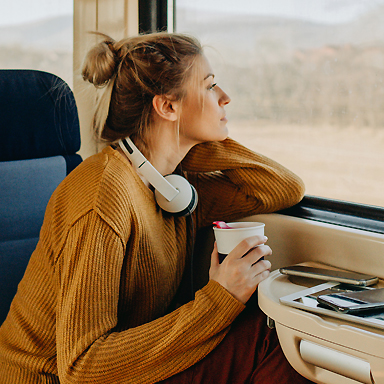
Patrick's advice? Take off your headphones and spend a few moments being present, hearing the sounds of the conversations around you
Embrace the spirit of slow travel
Patrick also encourages first-time Interrailers to slow down, stay curious, and make the most of the experience unfolding around them.
“Press pause – it's tempting to put your headphones on and curate your scenic soundtrack while gazing out the window. But tuning out with your earbuds in also shuts you off from the full experience.
It's nice to periodically take out your headphones, try to decode local languages you overhear, or listen to the proper pronunciation of stops you've only seen in writing.
Having headphones on also signals to people you don't want to talk – taking them off might lead to an interesting conversation with a fellow traveller.”

Sarah C enjoys a plate of fresh mussels at a seaside restaurant, embracing the local flavours of her destination
Eat like a local
One of the best ways to experience a new destination is through its regional cuisine. For Patrick, the secret to finding local delicacies while travelling is to follow the locals:
“Trains are great because you are travelling with locals and commuters. People who frequently pass through a station are more likely to know the best eats there, particularly foods perfect for travel. Look for food vendors at the station with the longest line or highest foot traffic.”
Hannah is also a foodie, and she believes that “food tours are great ways to get to know the city AND enjoy local food.”

Hannah's advice? Be prepared for cancellations, delays, crowded trains, and the occasional dash across the platform
Not every trip goes to plan
No matter how carefully you plan your Interrail trip, things don't always go according to your schedule. Hannah's advice is to embrace the unexpected:
“Be prepared for cancellations, delays, or crowded trains as part of the adventure. Use it as an opportunity to connect with other travellers, grab some snacks or find a bathroom.”
Change of currency
You cannot change the currency once you have a Pass in your cart. Remove the Pass, and then change the currency on the website header.